
2026: A Race Odyssey
Plus member news and upcoming Caversham Writers events

I’ve been going through my library at home with a view to having a clear out. (I’m not sure what makes me cringe more - the very idea of having a ‘clear out’ of old books or having the temerity to call the book collection in my spare room a ‘library’.)
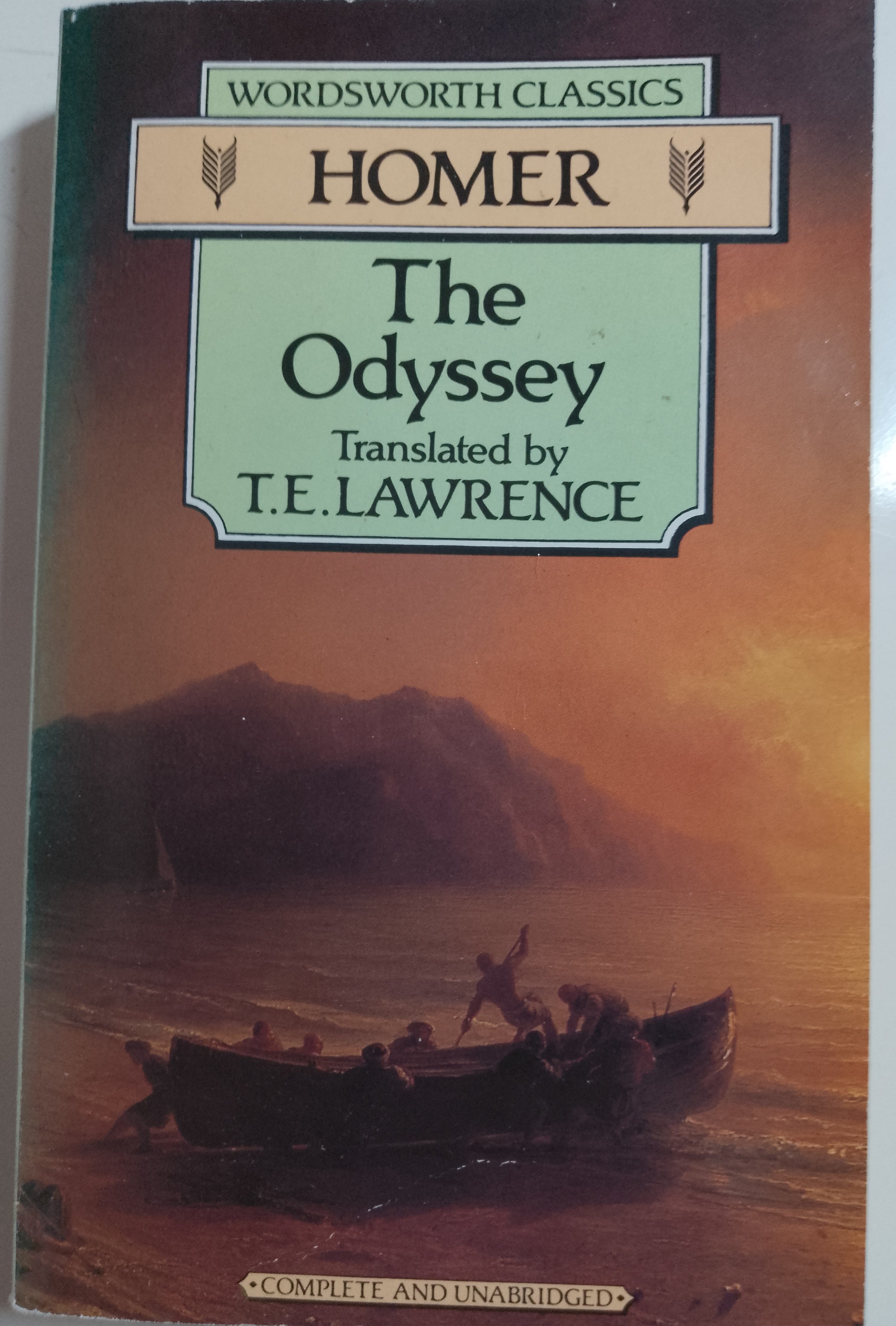
In an embarrassingly small section of classics, tucked away between never-thumbed copies of James Joyce’s Dubliners and Euripides’ Medea, I just stumbled across an edition of Homer’s Odyssey. How very topical.
I haven’t yet seen the Christopher Nolan movie, but I have taken notice of the public discourse surrounding the adaptation. Yesterday, the renowned white supremacist and melted Kim Jong Un lookalike Elon Musk weighed in on the subject yet again, saying “Before this year ends, Grok Imagine will make a full-length movie of The Odyssey that is historically accurate and true to the art of Homer.”
Don’t waste your time trying to imagine what a historically accurate Cyclops looks like, Musk is really only upset that Helen of Troy is played by a black actor, the magnificent Lupita Nyong’o, and by the casting of transgender actor Elliot Page in the movie.
A more serious discussion of historical accuracy would have to focus on translation of the original text. The original text itself could be subject to accusations of historical inaccuracy, given that Homer’s version was the synthesis of multiple tales and songs that had already been performed in an oral tradition for 500 years. Who knows how many changes those stories underwent before Homer finally wrote them down?
Nearly 3000 years later, we have plenty of modern translations to choose from. You’ll note from the photo above that my edition was translated by Lawrence of Arabia himself, T. E. Lawrence. His version is in prose with no attempt to replicate the verse of the original. It’s considered to be an idiosyncratic curiosity told from a soldier’s perspective, with Lawrence taking many liberties with the text. He frequently inserted his own phrases, embellishments, and modern concepts that do not exist in the original Greek. In the Translator’s Note in my copy, Lawrence says “I have been free with moods and tenses; allowed myself to interchange adjective and adverb; and dodged our poverty of preposition”.
The most famous recent translation is by Emily Wilson, a classical scholar who took pains to keep poetic structure. Homer’s original text is in dactylic hexameter, which works for Ancient Greek, but sounds weird in English. Wilson chose to translate the poem into iambic pentameter, familiar to us from Shakespeare, Milton, and Chaucer.
She also wanted to render the language more straightforward to a modern reader, while maintaining a sense of how unfamiliar and alien that ancient world is to our modern minds. No easy feat.
In her Substack essay on translating the beginning of the Odyssey, Wilson says of Lawrence’s version: “none of the first two lines corresponds to anything in the Greek in that place.”
Here’s a comparison of both translations of the opening lines.
Lawrence:
O Divine Poesy, goddess-daughter of Zeus, sustain for me the song of the various-minded man who, after he had plundered the innermost citadel of sacred Troy, was made to stray grievously about the coasts of men…
Wilson:
Tell me about a complicated man. / Muse, tell me how he wandered and was lost / when he had wrecked the holy town of Troy, / and where he went, and who he met, the pain…
I enjoyed her summary of Lawrence’s approach in that essay, saying he “refers to Homer’s great poem as a “novel”. It’s the Odyssey for lovers of H. Rider Haggard. For what it's worth, nine year old me adored King Solomon's Mines.”
Accurate translation is not just difficult, it is probably impossible. Not just from an ancient text, but also between modern languages. In modern Japan, Hungary or Mozambique the language has developed to express centuries of local geographic and cultural nuance. There is often no way of making all of that meaningful in English or Spanish or French. Now add 3000 years of history and try to express in English the inner mind and worldview of an Ancient Greek. It can’t be done.
I’ll not hold my breath for Musk’s detailed literary analysis of the text; I suspect if he ever does make an AI version of the film it’ll be mostly notable for Helen of Troy being depicted as the epitome of blue-eyed Aryan purity. I bet he loves Charlton Heston’s Moses almost as much as he loves Johnny Depp’s Tonto too.
Member News
Louisa Guise’s Radio Dacorum spoken word show is now onto episode 3. The broadcast editions go out on Wednesday evenings during our Caversham Writers events, but you can catch up on Mixcloud - this week Louisa spoke to author Lynda McCarthy, who left her publisher to go it alone and self-publish her first novel Twin Helix.
Member Sarah Swatridge wanted to let us know about a market for your short stories. She subscribes to a quarterly magazine called Scribble, which “publishes about 10-15 stories in each edition (up to 3000 words) and they run annual competitions. Readers are invited to send in their 1st, 2nd and 3rd and (helpful) comments. Once all the scores are added up, if overall yours comes 1st, 2nd or 3rd you earn £100, £75 or £25 respectively.”
Read more on writing for Scribble and their competitions on their website.
Caversham Writers Author Event
A reminder that next month we are hosting author Owen B Lewis in Fourbears Books:
Ask the Author! Meet Owen B Lewis
Wednesday, Aug 12 · 7:00 PM to 8:30 PM BST
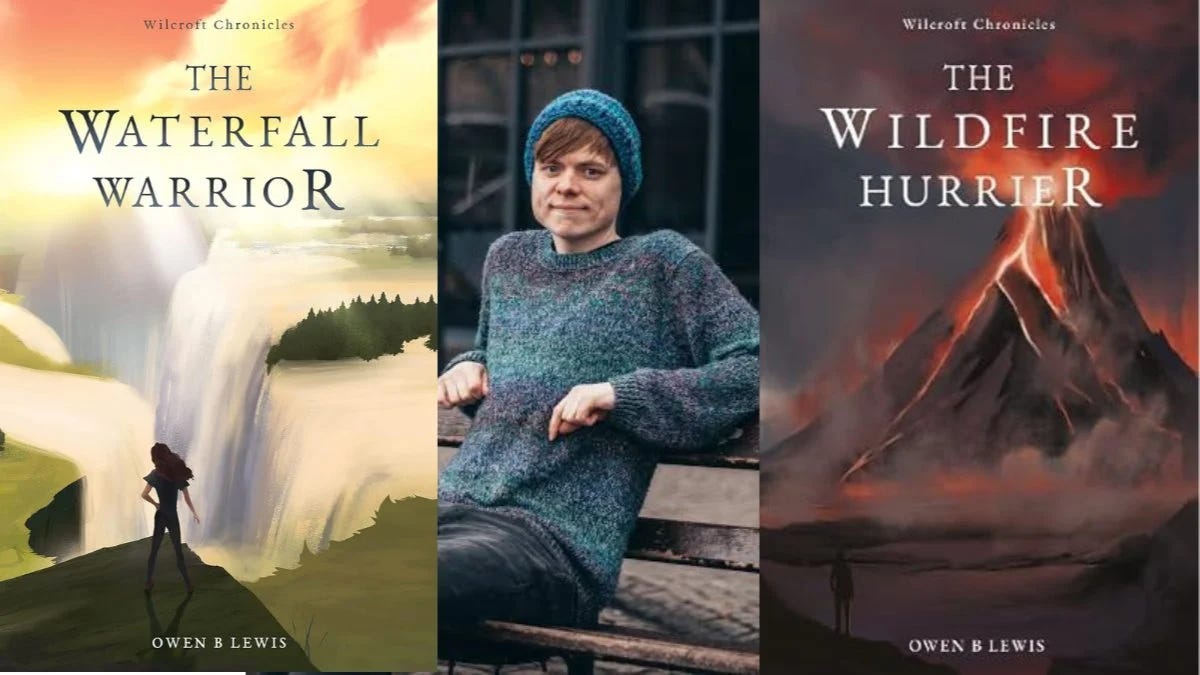
We spoke to Owen B Lewis on a Zoom session a couple of years ago (listen back here). This time Owen will be joining us in person at Fourbears Books to talk about the latest in his YA fantasy series. The Wildfire Hurrier was published in June.
Our Last Meeting
Write Night: Your Work in Progress
A warm welcome to new member Jacqui who joined us for the first time this week. Her work in progress is a story set in a small town in Pennsylvania: in this week’s writing session Jacqui worked on a scene involving miscommunication between characters meeting for the first time.
Stuart is nearing the end of a rewrite of a manuscript he first wrote a few years ago and made good progress this week to that end. Moira continued work on her romance novel, while Sarah started on a short story on the topic of ‘Dissent’ for a magazine competition.
Louisa set about writing a blog piece on the ever-controversial subject of AI in the writing and publishing world. Elaine is taking stock of the wealth of material she has accumulated and written on her prisoner of war project - assembling the material into a coherent plan. Abigail is using the time between submitting her novel to agents and waiting for a reply to research the self-publication route.
Next Week's Meeting
Bookshare Night - Your Summer Reading (online event)
Wednesday, July 29 · 7:00 PM to 9:00 PM BST
Need some inspiration for your summer reading list? Find out what your fellow Caversham Writers members are reading and recommending.
Join us for this online discussion and bring along a book (or two) you’d like to share with the group - it might be a current or recent read or an all-time favourite.
This event will be online via Zoom, register to attend on Meetup to get the link:
Free To Join, Free To Attend
As you know Caversham Writers is free to join and free to attend and I want it to remain so. That doesn’t mean it is free to run, though. I organise the group meetings on Meetup.com who have seen fit to double the fees paid by group organisers over the last year.
This has led to many groups shutting down or moving platform. I like to think of Caversham Writers as a local group with a global reach and I want us to remain open to voices from all over the world. Meetup provides that global reach so I intend to stay there, but would welcome any contributions toward the costs of running the group.
So if you enjoy this free newsletter and our weekly free events, please consider helping out by buying me a coffee at the link below.
I like Robert Fagles’ translation as well. It must have been wonderful, before it was written down, to gather around in a room lit with oil lamps and to listen to someone telling the entire story from memory.